
My First Time in Palestine: Seeing, Crossing, Understanding Occupation
Beatrice Forestan
 My first time in Palestine is an experience that will stay with me. Many people say that a first visit leaves a permanent mark, and I am beginning to understand why. For the first time, I witnessed with my own eyes the system of occupation and apartheid that shapes every aspect of Palestinian life.
I was there as a representative of Kairos Italy, for the launch of Kairos Palestine 2. At the same time, I was on the ground, encountering occupation through different and deeply concrete realities: the appropriation of water resources in the Jordan Valley, the apartheid wall cutting through Bethlehem like an open wound, and the testimonies of Bedouin communities living under constant settler attacks. This first experience allowed me to see and feel the occupation in its many interconnected forms.
Crossing a Checkpoint: When the Abnormal Becomes Everyday
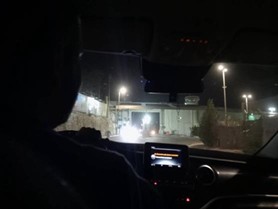 One of the most powerful moments of the trip was crossing checkpoints. Getting off the bus, walking through ID control, watching soldiers board and inspect the vehicle – this process made me reflect deeply on what it means to live under military occupation.
Palestinians are fully aware of the violations they experience. Yet when life unfolds within such a system, adaptation becomes a necessity in order to function. In this way, the abnormal becomes part of everyday life. This stands in stark contrast to my own reality, in Italy, where freedom of movement is something we rarely, if ever, question.
Movement Restrictions After October 7
During our visit, we met with the Balasan Initiative, an independent, non-partisan Palestinian initiative founded by young Palestinian Christians. It was described to us as a “small initiative”- not to diminish its significance, but to underline a deliberate choice: remaining agile, deeply rooted in the community, and free from the bureaucratic dynamics of large organisational structures that are often disconnected from the daily reality of violations on the ground.
Despite its size, Balasan carries out extensive, rigorous, and multidisciplinary work. Their activities combine documentation of violations, legal advocacy, research, policy analysis, field monitoring, and international awareness-raising. Their mandate covers the entire occupied Palestinian territory and is guided by a very clear principle: “All violations are violations, regardless of the perpetrator.”
This approach allows Balasan to address a wide range of issues, including annexation policies, settler violence, land confiscation, restrictions on freedom of movement, violations of cultural and religious rights, home demolitions, and processes of both direct and indirect forcible transfer.
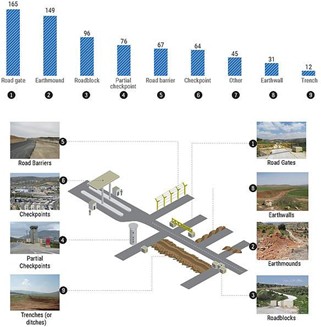 Balasan presented updated data on movement restrictions since October 7. According to their findings, there are now over 1,200 checkpoints, roadblocks, gates, and physical obstacles across the West Bank – the highest number ever recorded. Some are permanent, while many are so- called “flying checkpoints” that appear and disappear unpredictably, creating a constant state of uncertainty.The consequences are devastating:
- 100,000 work permits for Palestinian workers have been revoked;
- 44% of medical permit requests are denied;
- 150 farming communities have lost access to their land;
- and the obstruction of ambulances has tripled over the past year.
These restrictions are not minor inconveniences. They reshape every aspect of life, limiting access to work, healthcare, land, and even emergency medical response. (1)
Gender-Based Violence at Checkpoints
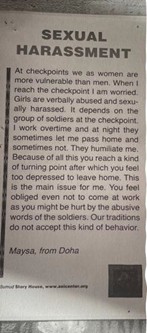 The most alarming update shared by Balasan concerns their newly released report on gender-based violence at checkpoints. The report documents how checkpoints have increasingly become spaces of militarised, gendered domination.
The testimonies reveal recurring patterns: women forced to undress, subjected to invasive body searches, beaten, insulted, and sexually humiliated. These acts are not isolated abuses, but part of a structural system aimed not only at controlling movement, but at breaking dignity.
The impact extends far beyond the checkpoint itself. Many women alter their daily routes, withdraw from work or educational opportunities, and live with lasting fear, shame, and trauma.
Understanding this gave a deeper meaning to my own experience of crossing a checkpoint. What is a moment of discomfort for us can be a site of profound vulnerability for Palestinian women. (2)
Jenin and the Trauma of Multigenerational Displacement
Another experience that deeply affected me was visiting people evacuated from the Jenin refugee camp following the “Iron Wall” military operation in January 2025.
Coming from a background in migration studies, I had long reflected on displacement. Being there, however, revealed something more profound: the reality of multigenerational displacement and its psychological consequences. Jenin camp was not merely a physical space. Like many refugee camps in Palestine, it had become a place of identity, continuity, and belonging for families already displaced in 1948.
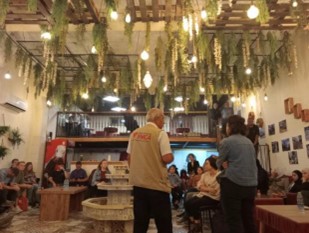 With the recent military operation, entire neighbourhoods were destroyed and thousands of people were forced to flee overnight, losing not only their homes, but their social fabric, routines, and sense of stability.
YMCA Rehabilitation Program staff shared that, compared to previous crises, this time something new has emerged: people are actively asking for psychological support. Parents overwhelmed by fear and uncertainty, children showing clear signs of acute stress, and families deeply traumatised by sudden, unannounced displacement carried out in the middle of the night.
For many, the trauma is not only physical. It is the loss of a place that represented safety, community, and identity. When displacement is repeated across generations, the psychological wounds become deep and enduring.
Naming Reality as It Is
This first trip to Palestine revealed to me how layered and pervasive occupation truly is. It is not only about land, but about bodies, emotions, identity, and the ability – or the inability – to feel safe, to belong, and to imagine a future.
One of the central messages of Kairos Palestine 2 is the refusal of euphemism. Naming reality clearly, without softening language, is essential. When we speak about what we have witnessed, we carry the responsibility to describe it truthfully – not as “tensions” or “conflict,” but as systemic violence, apartheid, displacement, and, as the authors write, a reality that today emerges “from the heart of a genocide.”
All of this is possible only through impunity – an international impunity that allows violations to continue without consequences. Breaking that impunity begins with telling the truth, rejecting vague language, and demanding accountability from governments, institutions, and churches.
If there is one message I carry with me from the organisations we met – from Balasan to the YMCA- it is the importance of ensuring that these stories do not remain invisible. Speaking about what we have seen is a responsibility. Challenging the normalisation of violations is a necessity. Continuing to advocate for dignity, justice, and human rights is essential.
Beyond Weapons: Militarisation, Youth, and the UK Debate
Reflecting on these experiences also pushed me to think more broadly about militarisation – not only as something visible through weapons, uniforms, or checkpoints, but as a social process that shapes how people think, speak, and understand the world.
Military systems do not only train bodies. They shape perceptions, language, and moral frameworks. From a very young age, individuals are socialised to obey authority, to perceive threat as permanent, and to normalise the use of force as a form of protection. Over time, these ideas become embedded in everyday thinking and become difficult to question.
In the Israeli context, this process begins long before enlistment. It is woven into school curricula, national commemorations, and dominant media narratives that frame reality primarily through the lens of security. Mandatory service in the Israel Defense Forces then consolidates this conditioning. Young people – often between 18 and 21 years old, before having any real civilian life experience-are placed in positions of power over another population. Palestinians are framed primarily as security threats, while military actions are presented as defensive and inevitable rather than as political choices.
This produces a form of systematic conditioning. Violence becomes routine, morally justified, and rarely questioned. What is often described as “brainwashing” is not a single act of propaganda, but a long-term social process that narrows how security, responsibility, and moral agency are imagined.
These reflections feel particularly relevant in light of the current debate in the UK around proposals for a military “gap year” for young people. When military service is presented as an opportunity – a way to build skills, leadership, and character – it is important to ask what kinds of values and assumptions are also being transmitted. Militarisation does not begin with deployment or combat; it begins much earlier, by shaping how young people are taught to relate to authority, discipline, violence, and the idea of security itself.
The question, then, is not simply whether young people gain transferable skills. It is whether early exposure to military structures normalises the use of force as a solution to political and social problems, and whether it limits the space to imagine alternative forms of security grounded in justice, care, and international responsibility.
My time in Palestine made clear that systems of occupation and militarisation depend not only on laws and weapons, but on deeply ingrained ways of thinking that are reproduced across generations. Engaging critically with proposals like a military gap year is therefore not an abstract exercise. It is part of a broader responsibility to reflect on how societies shape young people’s moral frameworks-and on what kind of future those frameworks make possible.
Questioning militarisation, wherever it occurs, is a necessary step toward imagining forms of security rooted not in domination and force, but in dignity, accountability, and shared humanity. (3), (4)
Footnotes:
1 Balasan Initiative for Human Rights (November 2025). – The Architecture of Coercion, Subjugation, and Domination: Israel’s Intensified Movement Restrictions in the West Bank Report, Infographic, and Factsheet
2 Balasan Initiative for Human Rights (August 2025), THE HIDDEN WAR ON PALESTINIAN WOMEN: Israeli Checkpoints as Sites of Systematic Gender-Based Violence Against Palestinian Women
3 GOV.UK (27 December 2025) https://www.gov.uk/government/news/armed-forces-to- launch-gap-year-scheme-for-young-people-to-bolster-skills-and-leadership
4 Aneesa Ahmed (27 December 2025): https://www.theguardian.com/uk- news/2025/dec/27/ministry-of-defence-to-offer-gap-year-style-scheme-to-young-people
Beatrice Forestan is a Master’s student in Human Rights and Humanitarian Action at Sciences Po – Paris School of International Affairs. She currently works with SOS Mediterranee, contributing to the defense of the right to life in the Mediterranean, and has gained extensive experience in migration-related contexts across Europe, working closely with people on the move.